What Is a Wedding Music Deposit? Your 2026 Guide
- May 30
- 8 min read

A wedding music deposit is the upfront payment couples make to reserve a music vendor’s date and confirm the booking. Without it, your chosen DJ, band, or pianist has no obligation to hold your wedding date. This payment typically ranges from 25% to 50% of the total contract value, and it triggers the formal start of your working relationship with the vendor. Understanding how deposits work, what they cover, and what happens if plans change will save you money and prevent serious disputes on one of the most important days of your life.
What is a wedding music deposit and how much should you expect to pay?
A wedding music deposit is the upfront payment couples make to secure a vendor’s booking date, typically ranging from 25% to 50% of the total fee for DJs. That percentage range translates into real dollars quickly. According to The Knot, the average wedding band costs $4,500 while the average DJ runs $1,800. That means a DJ deposit for weddings typically falls between $450 and $900, while a wedding band deposit can reach $1,125 to $2,250 depending on the vendor.
Several factors push deposits higher or lower. Vendor reputation is the biggest driver. A highly sought-after live musician in Los Angeles or Beverly Hills who books 18 months out will require a larger deposit than a newer vendor with open availability. Location matters too. Southern California markets, particularly in Orange County and San Diego, carry premium pricing that directly affects deposit amounts. Demand timing also plays a role. Booking a Saturday in June will almost always require a higher deposit than a Tuesday in January.

Some vendors set a fixed deposit amount rather than a percentage. A vendor might require a flat $1,000 deposit with the final payment due one week before the event. This structure is common among established solo musicians and boutique entertainment companies. Whether percentage-based or fixed, the deposit functions as both a reservation fee and a contract confirmation.
Vendor type | Average total cost | Typical deposit (25%–50%) |
Wedding DJ | $1,800 | $450–$900 |
Wedding band | $4,500 | $1,125–$2,250 |
Solo pianist | $800–$2,500 | $200–$1,250 |
String quartet | $2,000–$5,000 | $500–$2,500 |
What does a deposit for wedding music actually cover?
A wedding music deposit covers far more than a placeholder on the vendor’s calendar. The moment you pay, the vendor begins work on your behalf. That work includes pre-event consultations, playlist customization, equipment testing, and logistics coordination with your venue. These are real hours that cannot be recovered if you cancel.
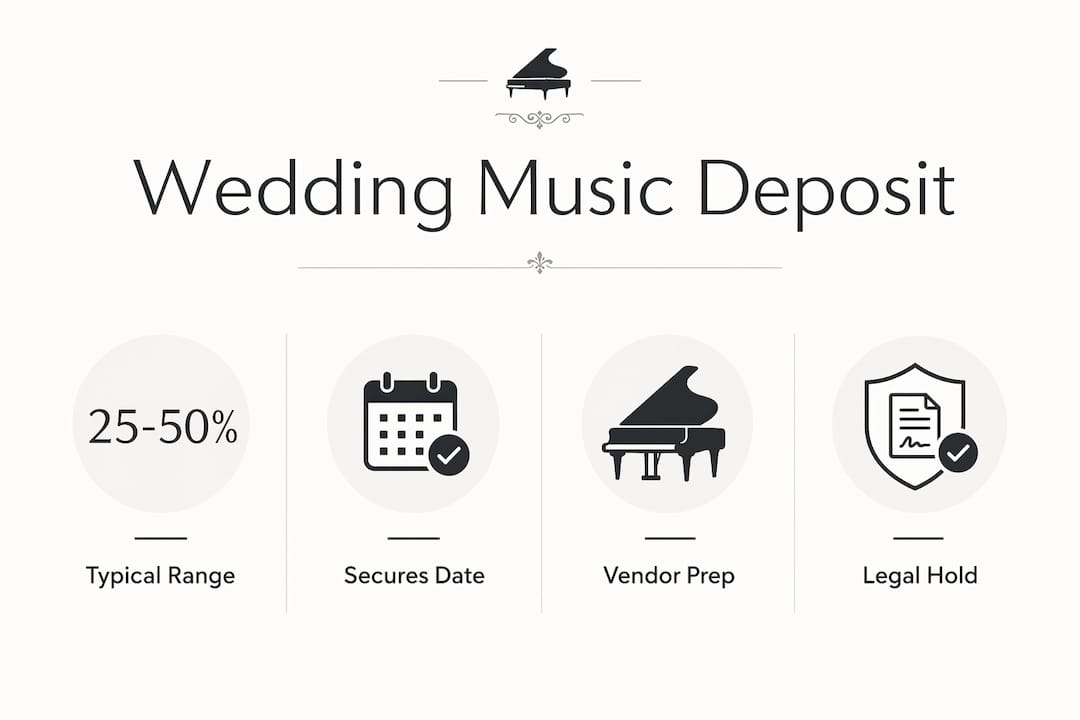
The deposit also compensates the vendor for lost opportunity to book other clients on your date. A professional musician who turns away three other inquiries for your Saturday in October has absorbed a genuine financial risk. The deposit is the mechanism that makes that risk fair for both sides.
Here is a breakdown of what your deposit secures:
Date exclusivity. The vendor removes your date from availability and declines competing inquiries.
Pre-event planning. Consultations, questionnaires, and timeline reviews begin immediately after signing.
Playlist and repertoire preparation. Custom song selection, learning new material, and arranging specific requests take real rehearsal time.
Equipment preparation. Sound checks, gear maintenance, and venue-specific technical planning are done in advance.
Vendor accountability. The signed contract and deposit create mutual legal commitment on both sides.
Pro Tip: Ask your vendor for a written breakdown of what the deposit covers before you sign. A vendor who cannot explain what your money funds in the pre-event period is a vendor worth reconsidering.
The deposit also protects you as a couple. Once a vendor accepts your deposit and signs the contract, they are legally obligated to perform on your date or face breach of contract consequences. That mutual commitment is the real value of the wedding music booking deposit.
How do refunds and cancellation policies work for music deposits?
This is where couples most often get surprised, and where reading the contract carefully makes an enormous financial difference. The single most important distinction in any wedding music contract is whether your payment is labeled a deposit or a retainer. These terms are not interchangeable. Deposits may be refundable while retainers are generally non-refundable, and the contract wording determines which legal standard applies.
Term | Refundable? | Legal standard |
Deposit | Potentially yes | Depends on contract language and jurisdiction |
Retainer | Generally no | Compensation for services rendered or reserved |
Non-refundable booking fee | No | Explicitly waives refund rights at signing |
Booking fee | Varies | Ambiguous without additional contract language |
Most wedding music contracts use tiered cancellation policies. Cancellation timing determines how much of the deposit you forfeit. A cancellation 12 months out might result in a full refund or a small administrative fee. A cancellation 60 days before the event typically means losing the entire deposit. Some contracts tie partial refunds to whether the vendor successfully rebooks the date. If another client books your slot after you cancel, you may recover a portion of what you paid.
Consumer protections can override non-refundable clauses in certain situations. Some jurisdictions provide cooling-off periods during which you can cancel any service contract without penalty. A Korean consumer dispute case resulted in a refund being ordered despite an explicitly non-refundable clause, demonstrating that local consumer law can supersede contract language. Courts generally uphold non-refundable deposits as liquidated damages when the clause is clearly defined, but ambiguous wording tends to favor the couple in disputes.
Pro Tip: Before signing, ask the vendor directly: “If I cancel six months out, what happens to my deposit?” Their answer, and whether it matches the written contract, tells you everything you need to know about how they handle disputes.
The clearest contracts specify exact dollar amounts or percentages forfeited at each cancellation milestone. Vague language like “deposit is non-refundable under certain circumstances” is a red flag. Demand specificity in writing before you pay anything.
When and how should you pay your wedding music deposit?
The sequence of payment matters as much as the amount. Paying a deposit before the contract is signed leaves both parties legally unprotected and creates real risk for disputes. The industry standard is clear: sign the contract first, then pay the deposit. Never reverse that order.
Here is the payment sequence that protects you at every stage:
Receive and review the contract. Read every clause, including cancellation terms, force majeure provisions, and what happens if the vendor cannot perform.
Negotiate any terms before signing. Once you sign, the terms are locked. This is your only window to request changes.
Sign the contract. Both parties sign before any money changes hands.
Pay the deposit immediately after signing. Delaying payment after signing can give the vendor grounds to release your date.
Confirm receipt in writing. Get a written confirmation that your deposit was received and your date is secured.
Track the final payment deadline. Most vendors require the remaining balance one to two weeks before the event.
Splitting payments into milestones helps both vendors and couples manage financial risk at each stage of the planning process. Some vendors offer a three-payment structure: deposit at signing, a mid-planning installment, and the final balance before the event. This approach is increasingly common among live musicians who take on significant preparation work months in advance.
Accepted payment methods vary by vendor. Credit cards offer the strongest consumer protection if a dispute arises. Bank transfers and checks are common but offer fewer dispute options. Some vendors use planning portals or invoicing platforms that create a digital paper trail. Whatever method you use, always request a receipt that specifies the date, amount, and what the payment covers.
Key takeaways
A wedding music deposit is a legally binding payment that secures your date, funds vendor preparation, and creates mutual accountability. Understanding the contract terms before you pay is the only way to protect yourself financially.
Point | Details |
Deposit range | Expect 25%–50% of total cost, translating to $450–$2,250 depending on vendor type. |
What it covers | Date exclusivity, pre-event planning, playlist prep, and vendor opportunity cost. |
Deposit vs. retainer | Contract wording determines refundability; retainers are generally non-refundable. |
Payment sequence | Always sign the contract before paying any deposit to protect both parties legally. |
Cancellation policies | Tiered refund rules based on timing; earlier cancellations recover more of the deposit. |
What I’ve learned from years of booking weddings as a pianist
Most couples come to me having already signed a contract they did not fully read. They focused on the excitement of booking their entertainment and skimmed past the cancellation clause. I understand that impulse completely. But the deposit conversation is the moment where the business relationship either starts on solid footing or sets up future friction.
The terminology confusion between “deposit” and “retainer” is the most common misunderstanding I see. Couples assume that because they paid a deposit, they can get it back if something changes. That is not always true, and the contract is what decides, not the word used in conversation. I always encourage couples to ask vendors to walk them through the refund policy out loud, not just point to a paragraph. If a vendor gets defensive about that request, that tells you something important.
From my own experience as a live pianist in Southern California, I can tell you that the deposit is not about distrust. It is about the real work that begins the moment you book. I start learning requested songs, coordinating with venues, and planning logistics immediately after a contract is signed. That work has value, and the deposit reflects it honestly.
The couples who have the smoothest experience are the ones who treat the deposit conversation as a collaboration, not a transaction. Ask questions. Request clarity. And always, always get the cancellation terms in writing before you hand over a dollar.
— Petra
Book your wedding music with confidence through Platinumpianist

Platinumpianist offers live piano entertainment for weddings across Southern California, with a transparent booking process that includes a clear contract and straightforward deposit terms from the start. Petra brings her own piano to your venue, covering Orange County, Los Angeles, San Diego, and Beverly Hills. Every booking includes a written agreement that spells out exactly what your deposit covers, when the final payment is due, and what happens if plans change. If you are ready to secure your date with a professional wedding musician who takes the guesswork out of the payment process, explore the full range of wedding music services and reach out to check your date’s availability.
FAQ
What is a wedding music deposit?
A wedding music deposit is the upfront payment couples make to reserve a music vendor’s date and confirm the booking, typically 25%–50% of the total contract value. It funds date exclusivity and covers the vendor’s pre-event preparation work.
Is a wedding music deposit refundable?
Refundability depends entirely on the contract language. Payments labeled as retainers or non-refundable booking fees are generally not returned, while deposits may be partially refundable depending on cancellation timing and whether the vendor rebooks the date.
When should you pay a wedding music deposit?
Pay the deposit immediately after both parties sign the contract. Paying before signing leaves both sides legally unprotected and creates risk for disputes if something goes wrong.
How much is a typical DJ deposit for weddings?
A DJ deposit for weddings typically falls between $450 and $900, based on an average DJ cost of $1,800 and a standard deposit range of 25%–50% of the total fee.
What is the difference between a deposit and a retainer in a wedding contract?
A deposit may be refundable under certain conditions, while a retainer is generally non-refundable and compensates the vendor for reserving the date and beginning preparatory work. The contract wording, not the spoken agreement, determines which standard applies legally.
Recommended