Brand Event Music: Live Piano Guide for Southern California
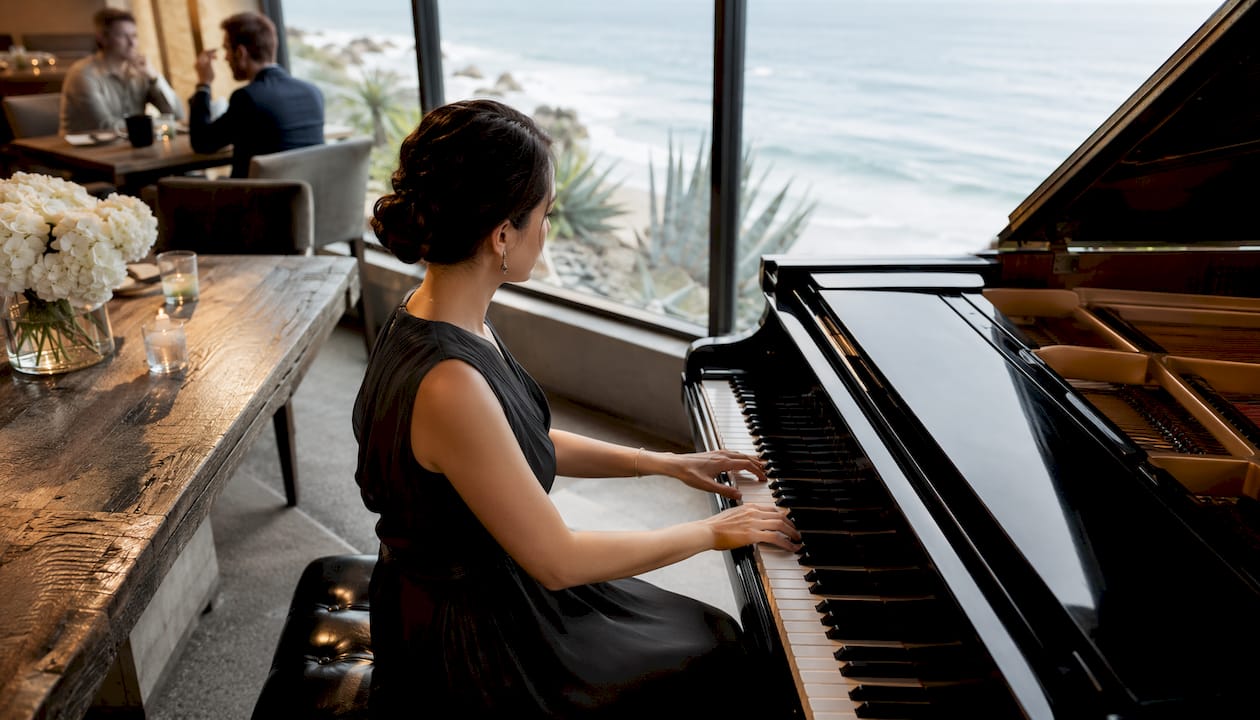
For upscale brand events in Southern California, the most effective music strategy starts with one decision: hire a live pianist who can deliver a consistent musical identity across every moment of your event. That means someone who arrives with their own instrument, understands your brand’s sonic persona, and can shift energy on cue without breaking the room’s atmosphere. Platinumpianist, featuring Petra, is designed exactly for this.
Before you do anything else, take three steps:
Confirm every event moment that needs music. Arrival, keynote walk-ons, dinner service, product reveal, awards walk-ons, and the after-reception are all distinct cues, not one continuous playlist.
Pick a primary musical persona. Cinematic minimalism, jazz-salon elegance, and ambient modern pop each create a different brand impression. Choose one and brief your musician around it.
Request a sample setlist and technical rider from any pianist you’re considering before you sign anything.
Pro Tip: Schedule a 20-minute consult with Petra at Platinumpianist before you finalize your venue walk-through. She can confirm piano placement, power needs, and musical mood in a single conversation, saving you a round of back-and-forth with your AV team.
Table of Contents
What does brand event music actually mean for your event?
Brand event music is a repeatable, recognizable sonic identity used deliberately across live moments, on-site programming, and content assets. It’s not background noise. Think of it as the musical equivalent of your brand’s color palette: consistent, intentional, and recognizable whether it’s playing during a keynote walk-on or looping in a 15-second social reel.
The mechanics of a musical DNA include:
Harmonic language: the chord vocabulary and key centers that feel “on brand” (warm jazz voicings vs. cool minimalist intervals)
Instrumentation palette: solo piano, piano with strings, or piano with light percussion
Tempo bands: the BPM ceiling for dinner service versus the energy floor for an awards walk-on
Edit-safe structural points: natural pauses that let editors cut without killing the phrase
Industry research from WithFeeling’s ADSW case study shows that treating music as a system across live ceremony, on-site programming, and social content creates cohesion and speeds production. At Social Media Marketing World 2026, a branded theme song repeated across sessions and social activations became a shareable earworm that reinforced the event’s identity long after the final session.
Pro Tip: Treat music as infrastructure, not a finishing touch. As DJ Will Gill notes, when music is aligned with the core message, it controls pacing and emotional arc. That’s the standard to hold your event to.
Music should be treated as infrastructure for multi-day summits, product launches, and awards ceremonies. For a small reception of under 50 guests, a curated ambient playlist is often sufficient.
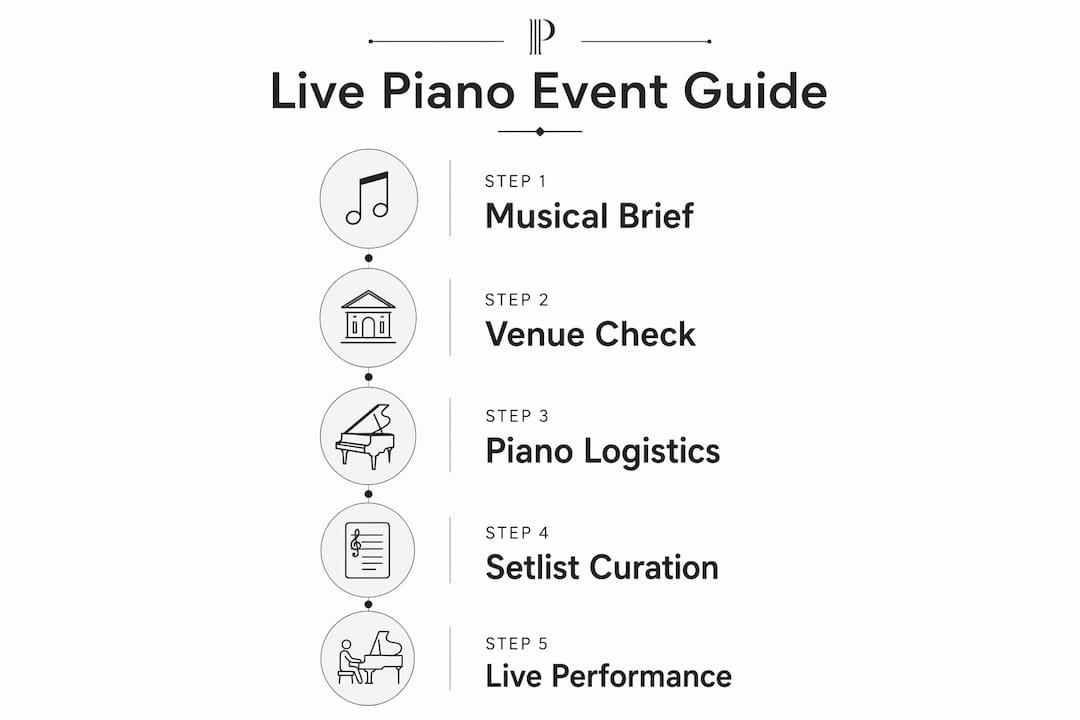
Why live piano works for upscale corporate events
Live piano carries a specific set of advantages that recorded music and most other live formats can’t replicate at a luxury brand event.
Core strengths:
Unobtrusive energy control: a pianist can read the room and soften the tempo during speeches without a jarring cut
Visual brand fit: a grand piano on stage signals a level of production quality that a speaker stack and a laptop do not
Seamless transitions: live piano fills the silence between a keynote and a standing ovation without dead air
Content capture value: a pianist performing during a product reveal creates a visually compelling, music-forward moment for social assets
Live music brand activations create episodic memory. When a song is performed at a charged moment, attendees encode the brand as part of a lasting experience, with higher recall and social sharing than passive sponsorships.
When solo piano is not the right call:
Large outdoor activations requiring amplified full-band energy across a wide footprint
High-footfall consumer activations where a DJ’s broader sonic range and volume are better suited to the crowd
Dance-floor-driven receptions where guests expect a band or DJ to drive movement
Practical indicators that piano is the right fit: small-to-mid ballrooms, cocktail receptions, VIP dinners, awards ceremonies, and product unveilings with intimate staging. If your venue holds under 500 guests and the event has a luxury or executive positioning, live piano is almost always the right call. For more on live music’s role in elegant events, Platinumpianist’s editorial archive covers the specifics.
Pro Tip: Ask your venue coordinator for the room’s natural reverberation time. A room with long reverb suits a solo grand piano beautifully; a dry, acoustically dead room may need a light PA reinforcement to carry the sound.
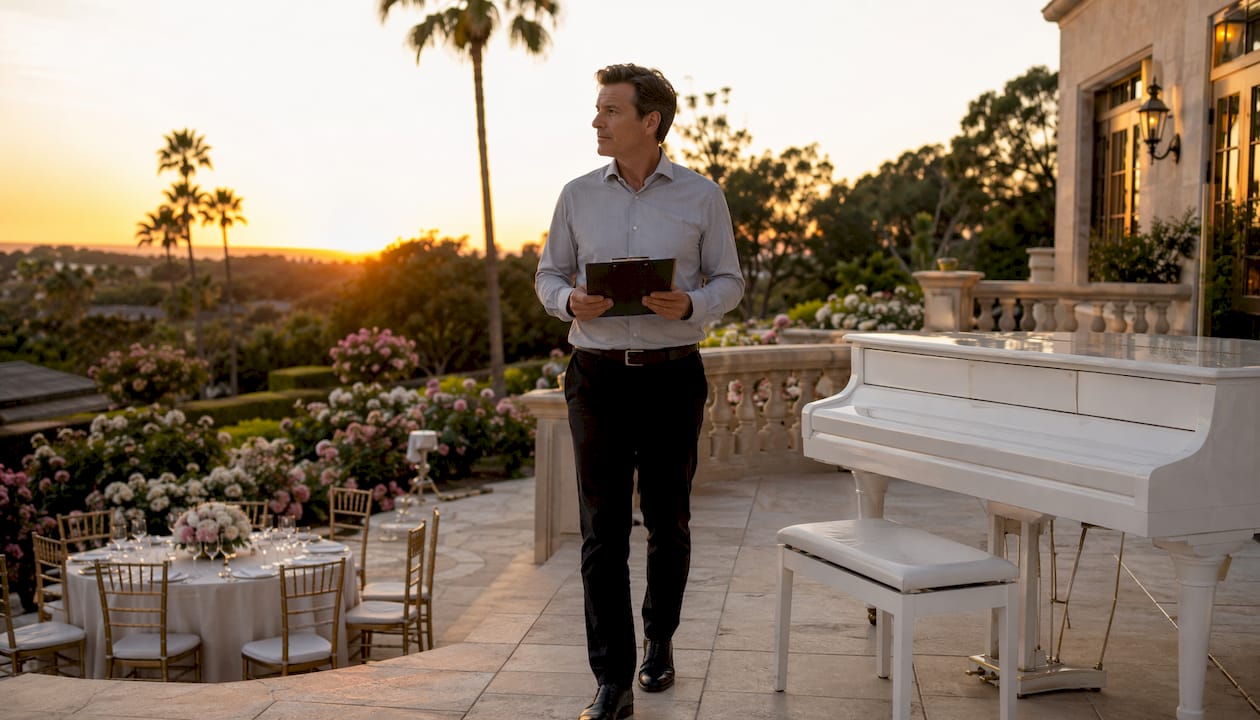
How to write a musical brief your pianist can actually use
A common failure in event production is booking talent without a clear musical brief, which produces generic sets that undercut brand atmosphere. A good brief takes 30 minutes to write and saves hours of post-event regret.
Essential brief fields:
Event moments and their desired energy (arrival: warm and understated; awards walk-on: confident and cinematic)
Target audience profile (executive, creative, mixed-generational)
Genres and eras to include or avoid
Lyrical restrictions (instrumental only, or specific lyric sensitivities)
Three reference tracks that capture the right feel
Run-of-show timings and cue lengths for each moment
Operational items to include:
Piano placement preference and stage dimensions
Soundcheck window (minimum 45 minutes before doors)
Point of contact for last-minute cue changes (show caller name and cell)
Camera and microphone isolation requirements for video capture
Insurance and certification documentation deadline
Quick brief checklist you can copy:
Two-tone musical persona (e.g., “cinematic minimalism with jazz-salon warmth”)
Three must-play songs with timestamps if specific sections matter
Two must-not-play examples
Desired walk-on and walk-out cue length in seconds
Show caller contact for real-time adjustments
For deeper guidance on crafting a musical direction for corporate events, Platinumpianist’s planner guide covers the full process.
Pro Tip: Send the pianist a 90-second video of the venue and a 30-second playlist sample before the site visit. It aligns expectations faster than any written description.
Logistics checklist for a pianist who brings a piano to your venue
Item | What to confirm |
Load-in window | Minimum 2 hours before doors; confirm with venue operations |
Elevator/door clearance | Baby grand requires standard door width and freight elevator access |
Stage dimensions | Minimum 8’ × 6’ footprint for a baby grand plus bench and performer space |
Power supply | 2 dedicated 20A circuits within 15 feet of the piano position |
Parking/truck access | Loading dock or street permit for instrument vehicle |
Outdoor cover | Full weather cover required; confirm with pianist if outdoor staging is planned |
PA integration | DI box or mic’d grand options; confirm with AV team in advance |
Liability insurance | Request certificate of insurance naming venue as additional insured |
Pro Tip: Share this table with your venue’s operations contact and your AV lead at least two weeks before the event. Surprises on load-in day cost money and create stress that shows up in the performance.
What does live piano cost in Southern California?
Pricing for a solo pianist in Southern California varies based on instrument delivery, event length, and travel distance. Illustrative ranges:
Solo pianist with digital piano: typically lower investment, suitable for cocktail hours and smaller receptions
Solo pianist with baby grand (self-supplied): higher investment reflecting instrument transport, tuning on-site, and setup time
Add-ons that affect price: travel beyond a defined radius, extended hours beyond the contracted set, required rehearsal with AV team, and post-event asset guidance
Booking norms to expect:
Deposits typically run a portion of the total fee at contract signing
Cancellation windows for premium talent in Southern California usually require advance notice to retain any deposit
Peak seasons for holiday events and awards season usually book several months in advance
Minimum viable notice for last-minute bookings is typically a few weeks, subject to availability
For regional context on event planning timelines in Southern California, Platinumpianist’s 2026 guide covers seasonal booking patterns in detail.
Sample setlists and a moment-by-moment music map
Cocktail/social hour (jazz-salon persona):
“Autumn Leaves” (Bill Evans arrangement, soft and conversational)
“The Girl from Ipanema” (instrumental, mid-tempo)
“Fly Me to the Moon” (Sinatra-era standard, warm and familiar)
“Blue in Green” (Miles Davis, ambient and sophisticated)
Seated dinner (cinematic minimalism persona):
Yann Tiersen-style original or arrangement (quiet, textural)
“La Vie en Rose” (slow, instrumental, emotionally resonant)
Nils Frahm-influenced ambient piece (modern, understated)
Transition/reveal moment:
A single-theme motif repeated in three variations: soft entry, full statement, and a quiet resolution as the reveal completes
Moment-by-moment music map:
Arrival (0–20 min): warm jazz standards, 70–80 BPM, conversational energy
Welcome remarks: pianist holds or fades to silence on show caller cue
Plated dinner: cinematic ambient, 60–70 BPM, no strong melodic hooks that compete with table conversation
Product reveal: motif builds from soft to full over 60–90 seconds, then resolves
Awards walk-ons: confident, rhythmic, 90–100 BPM, 15–20 seconds per walk-on
After-dinner reception: upbeat standards or soft pop, energy rises gradually
For selecting specific songs that match your brand voice, Platinumpianist’s song-selection guide covers lyric sensitivity and era preferences in detail.
Pro Tip: For content capture, record the reveal and awards walk-on moments music-forward. Request a dry piano stem from your AV team so editors can treat the music as a mix element rather than a fixed bed, which simplifies social edits significantly.
“Brief live entertainers with event narrative, audience demo, and desired energy per segment rather than asking them to ‘play background music.’ A musician who knows the story of the event plays it differently.” — WithFeeling, ADSW 2026 case study
Platinumpianist is the live piano specialist for Southern California brand events
Petra brings her own piano to your event, which removes one of the most common logistical headaches in luxury event production: sourcing and tuning a venue instrument. The service model runs from an initial consult through a tailored musical brief, site visit if needed, confirmed setlist and technical rider, and a post-event asset guidance session for your content team.
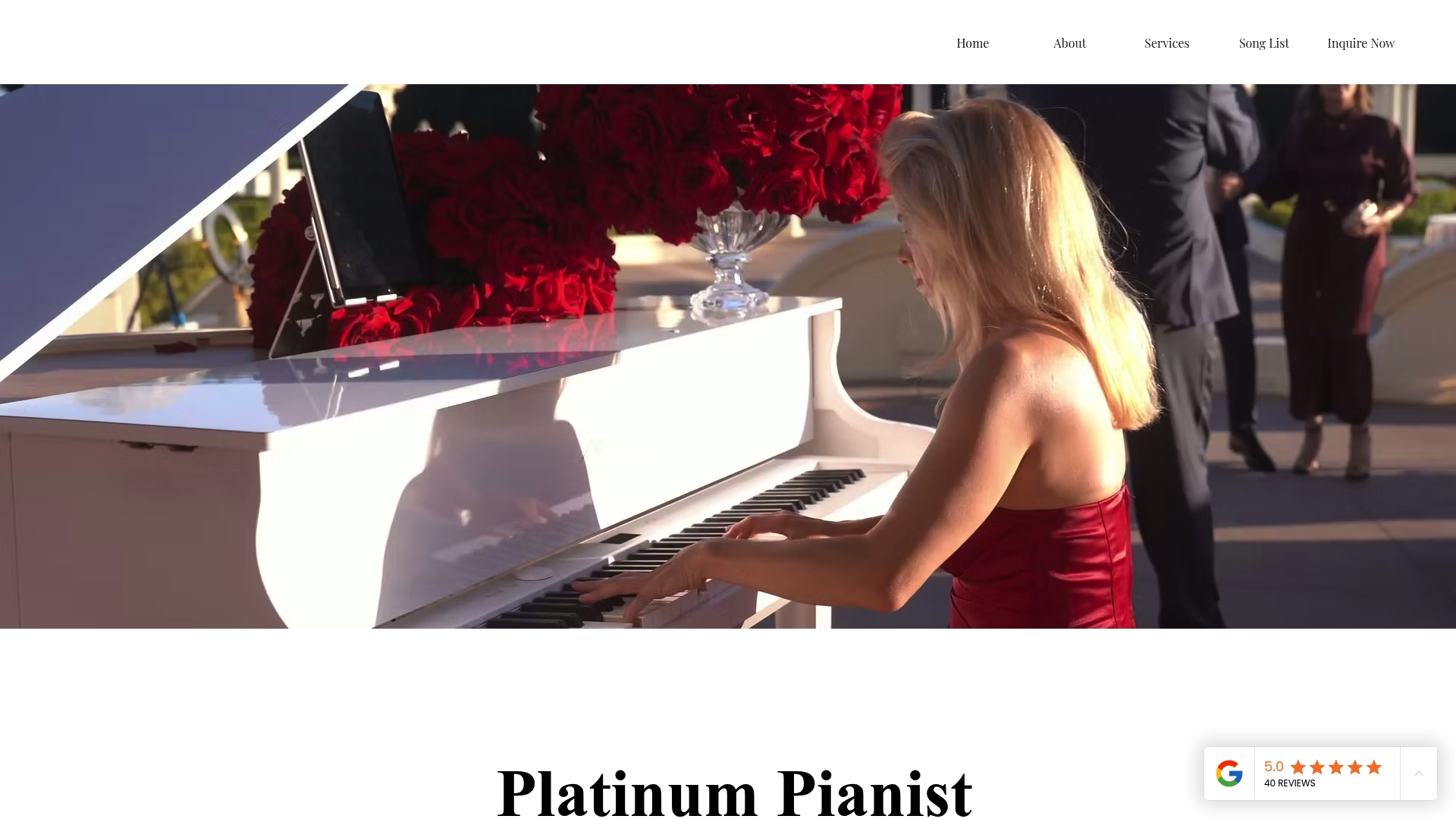
What Platinumpianist delivers: a curated, brand-appropriate repertoire built around your brief, rehearsal coordination with your AV team and show caller, proof of insurance, and references from prior corporate and brand events in Southern California. The live music impact Petra creates is documented across a portfolio of upscale corporate and private events.
Research on live music engagement consistently shows that live performance outperforms recorded music for audience connection and event recall, which is exactly the outcome brand clients are paying for.
To book a consultation or request a sample setlist, visit Platinumpianist’s corporate event music page or the private corporate service page. If your event is in Beverly Hills or the surrounding area, the Beverly Hills musician page covers local logistics and availability.
Key Takeaways
Live piano is the most brand-safe, logistically controllable choice for upscale Southern California corporate events when you brief the musician clearly, confirm logistics early, and book a specialist like Platinumpianist who brings her own instrument.
Point | Details |
Music is infrastructure | Treat event music as a system across live moments and content, not a finishing touch. |
Brief clearly and specifically | Give your pianist event moments, energy targets, reference tracks, and run-of-show timings before the site visit. |
Confirm logistics early | Lock in stage dimensions, power supply, load-in window, and PA integration at least two weeks out. |
Book ahead for peak seasons | Southern California’s holiday and awards seasons fill 3–6 months in advance; last-minute bookings require 2–3 weeks minimum. |
Platinumpianist for Southern California | Petra brings her own piano, coordinates with your AV team, and delivers a tailored musical brief for luxury brand events. |
What makes music feel owned by the brand
Most event planners think about music last. I think about it first, because the moment guests walk in, the piano is already telling them what kind of event this is going to be. A warm jazz voicing says one thing; a cool, sparse cinematic phrase says something entirely different. Neither is wrong, but the choice has to be deliberate.
What I’ve learned from working brand events is that the brief is everything. When a client shares the event narrative, the audience profile, and even a short video of the venue before we meet, the performance is different. Not just technically better, but emotionally coherent. The music feels like it belongs to the brand rather than being rented for the evening.
The other thing planners underestimate is the value of involving the pianist in the show-caller conversation. When I know the exact cue for a product reveal or an awards walk-on, I can build to it. When I’m guessing, I’m reacting. The difference in the room is audible. Bring your musician into the production conversation early, share the run-of-show, and the music stops being background and starts being part of the story.
Recommended


