What Does an Event Pianist Do? A Planner's Guide
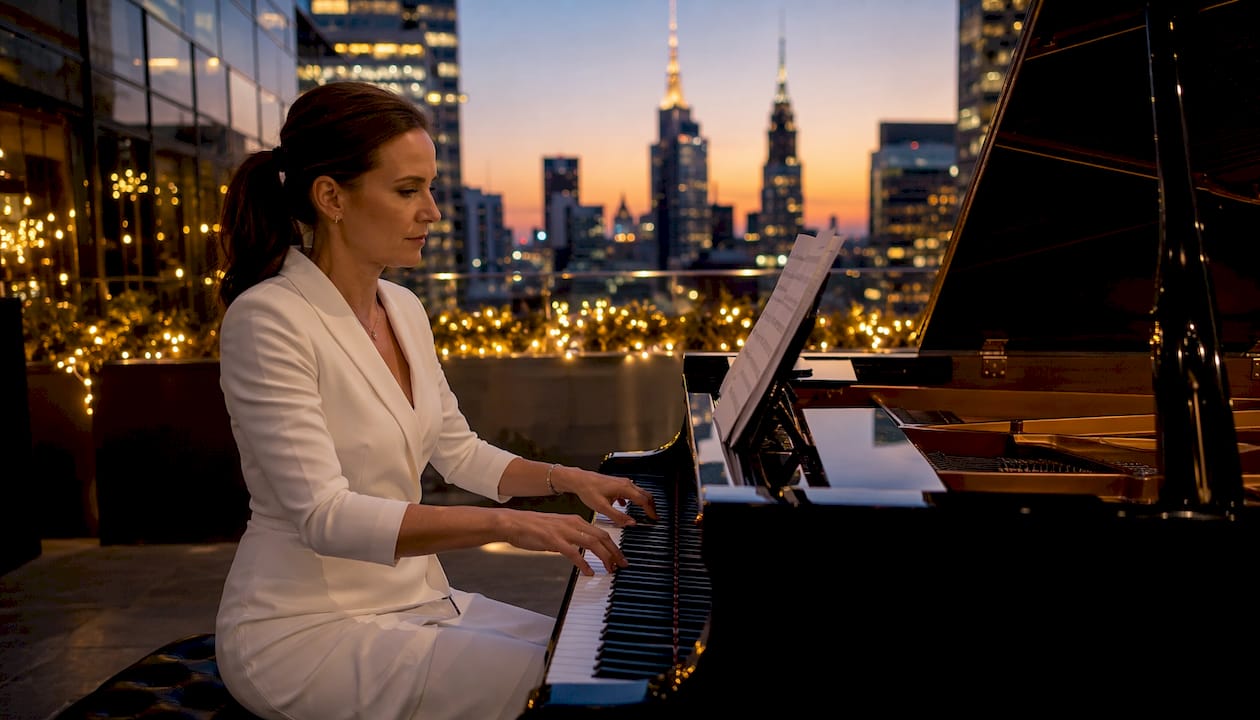
An event pianist provides live, adaptive piano music that shapes an event’s atmosphere, supports key transitions, and works alongside your event team to keep everything running smoothly. Whether you’re planning a wedding ceremony, a corporate reception, or a private gala, the pianist’s job goes well beyond sitting down and playing songs.
TL;DR: A professional event pianist consults with you before the event, arrives early to set up and soundcheck, reads the room in real time to adjust volume and repertoire, and coordinates with your AV team and MC so every moment lands the way you planned it.
Here’s what that looks like in practice:
Atmosphere control: Sets the emotional tone from the moment guests arrive through background music calibrated to the room’s energy.
Ceremony accompaniment: Plays processionals, recessionals, and signing music timed precisely to the moment.
Reception and dinner sets: Provides continuous background music that supports conversation without competing with it.
On-the-day adaptability: Adjusts tempo, volume, and song choices based on guest behavior, lighting shifts, and cues from the planner or MC.
Vendor coordination: Communicates with AV technicians, event coordinators, and other performers to ensure smooth handoffs.
Platinumpianist, a Southern California live piano service, is a strong example of this full-scope role in action: she arrives with her own portable piano shell, PA system, and a pre-planned setlist built around your event’s specific moments.
Table of Contents
What does an event pianist do before, during, and after your event?
The scope of a pianist’s work starts weeks before the first guest walks in. Understanding the full timeline helps you set expectations and write a better brief.
Before the event
The pre-event phase is mostly consultation and logistics. A professional pianist will schedule a call or email exchange to confirm your event type, the moments that need music, and any specific songs you want. From there, she builds a repertoire plan, which might include jazz, classical, pop, or contemporary arrangements depending on your event’s tone.
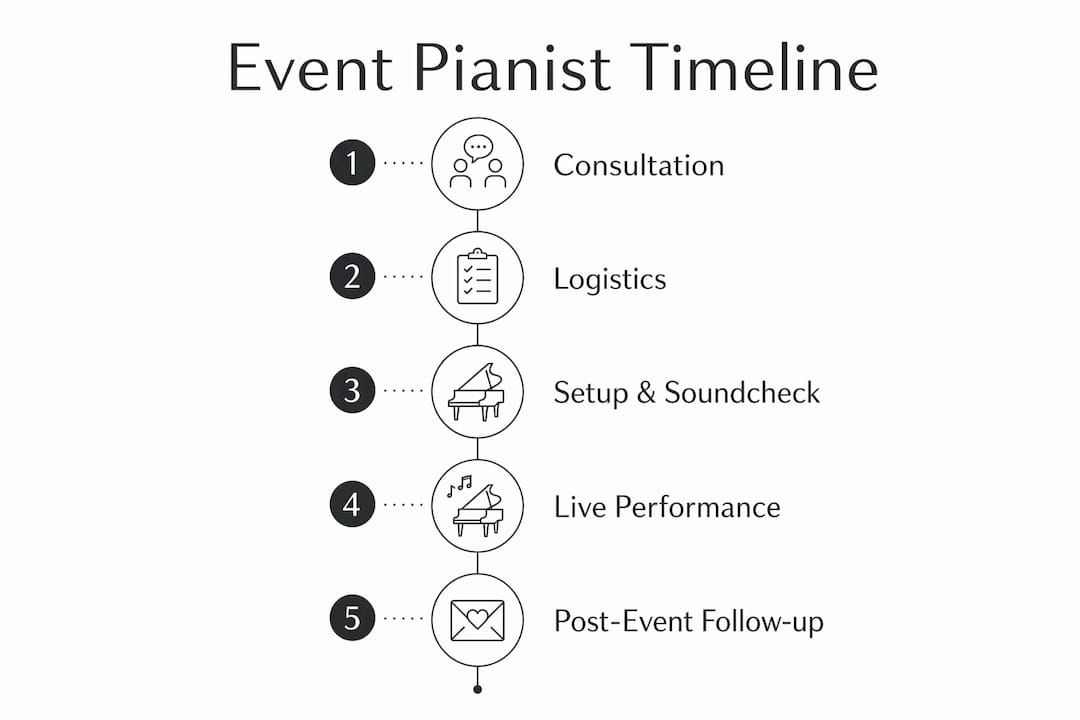
She’ll also confirm the logistics: Is there a house piano, or does she need to bring her own instrument? Is there a loading dock or elevator access? What time does the venue allow load-in? These questions matter more than most planners expect, and a good pianist raises them without being asked.
Contracts and riders come next. A rider typically specifies power requirements, staging dimensions, parking, and any hospitality needs. If you’re working with a pianist directly rather than through an agency, review the rider carefully before signing.
Arrival, setup, and soundcheck
Most pianists arrive roughly one hour before their first performance set. That window covers instrument placement, cable runs, PA connection or microphone positioning, and a soundcheck to confirm levels in the actual room. Acoustics change when a space fills with people, so a good pianist accounts for that during the check.
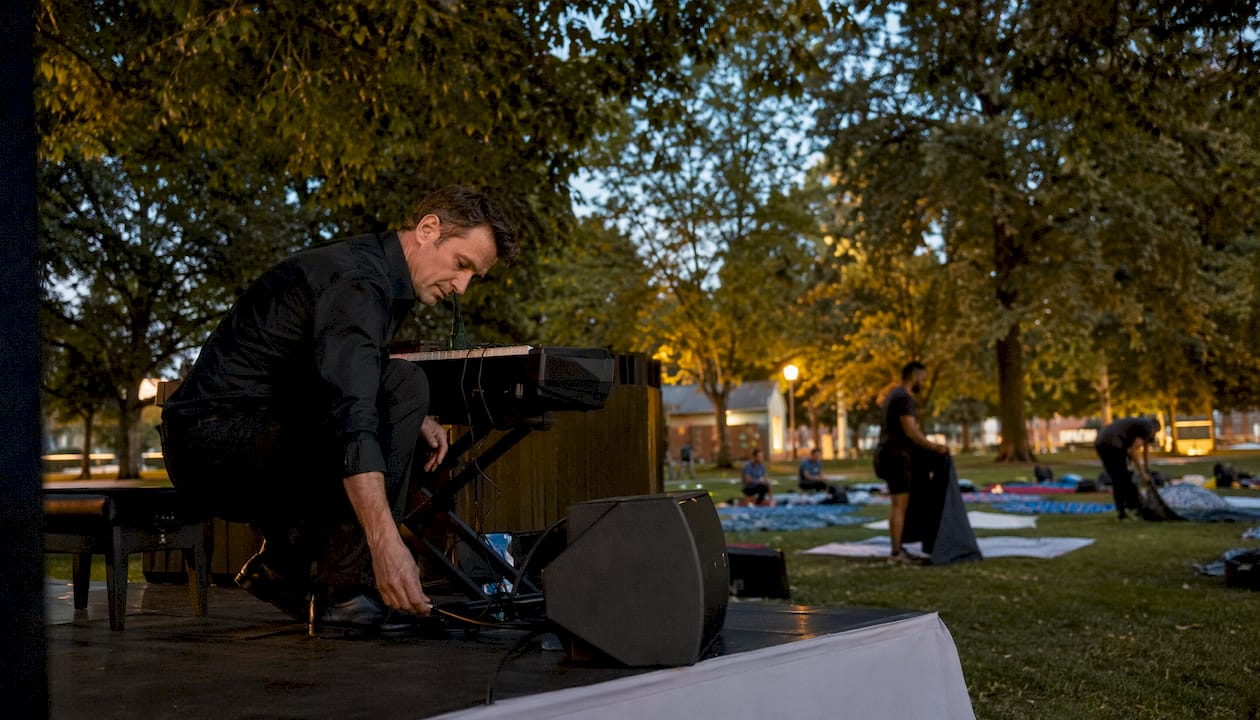
Last-minute song requests often come in during this window too. A prepared professional handles them without disrupting setup.
Pro Tip: Ask your pianist to confirm her arrival time in writing and build a 15-minute buffer into your run sheet. Venues sometimes delay load-in access, and that buffer prevents a scramble before guests arrive.
During the event
This is where the real skill shows. The pianist reads the room continuously, adjusting volume when conversation picks up, shifting to a more energetic piece when energy dips, and pausing cleanly for speeches or announcements. She tracks the event timeline, cues from the MC or planner, and any last-minute changes to the order of events.

For ceremonies, timing is precise: the processional starts when the wedding party enters, the signing music fills the exact minutes needed, and the recessional hits the moment the couple turns to walk out. For receptions and dinners, the work is more fluid but no less deliberate.
After the event
Teardown, equipment pack-out, and a brief check-in with the planner close the day. Some pianists offer a follow-up note confirming everything went as planned, which is useful if you’re writing a vendor review or booking them again.
Planner logistics checklist (copy into your run sheet):
Confirm pianist arrival time and load-in access with the venue
Verify power outlet location and distance from piano placement
Share the final event timeline at least 48 hours before the event
Designate one point of contact (you or your MC) for on-the-day cues
Confirm repertoire approval at least one week out
Clarify teardown window so the pianist doesn’t conflict with venue reset
How does a pianist’s role change by event type?
The core skills stay the same across every booking. What changes is the structure, the repertoire, and how the pianist fits into the event’s flow.
Weddings
Weddings typically involve two or three distinct performance blocks: the ceremony, the cocktail hour, and sometimes a dinner reception. The ceremony set is the most structured, with specific songs tied to specific moments. A typical ceremony sequence runs something like this: 20 minutes of prelude music as guests are seated, a processional for the wedding party, a processional for the bride or couple, two or three pieces during the signing of the register, and a recessional. The pianist then moves to the cocktail or reception space and continues playing for the remainder of her time.
Piano suits upscale weddings particularly well because it covers the full emotional range of a ceremony without requiring a full band setup.
Corporate events
Corporate bookings tend to be more straightforward in structure but more demanding in terms of background music discipline. The pianist plays at conversation level, keeps the energy consistent, and avoids anything that pulls attention away from networking or presentations. Corporate events typically have the pianist on-site for one to four hours, covering arrival drinks, dinner, or a hospitality suite. For trade shows, the guidance is clear: background piano at conversation volume with careful placement away from high-traffic booth areas.
Private parties and galas
Private events give the pianist the most flexibility. Depending on the host’s preferences, the set might include singalongs, guest requests, or a higher-energy mix that shifts the room’s mood as the evening progresses. Galas often blend background dinner music with a more featured performance moment, sometimes including a vocalist.
Event type | Typical duration on-site | Primary role | Repertoire style |
Wedding ceremony + cocktail | several hours | Ceremony timing, background | Pop, classical, contemporary |
Corporate reception | 1–4 hours | Background, conversation support | Jazz, instrumental covers |
Trade show / hospitality suite | 1–4 hours | Ambient, low-volume background | Jazz, light classical |
Private party / gala | 2–4 hours | Flexible, requests welcome | Mixed genres, singalongs |
What logistics and technical requirements should you confirm?
Getting the technical side right is where many planners lose time. Here’s what to lock down before the event.
Instrument options
The choice between a house acoustic piano and a pianist-supplied digital keyboard shapes everything from sound quality to load-in complexity.
Instrument | Pros | Cons |
House acoustic (grand or upright) | Rich tone, visual impact, no transport | Requires tuning, fixed location, not always available |
Pianist-supplied digital keyboard | Portable, consistent tuning, volume control | Less visual presence than a grand piano |
Portable piano shell (digital inside) | Aesthetic of a grand, portability of digital | Requires power, PA connection |
Platinumpianist brings her own portable piano shell in white or black, which solves the aesthetic problem most digital keyboards create. It looks like a grand piano and travels like a keyboard rig.
Amplification and power
For audiences up to roughly 50 guests in a quiet indoor space, an acoustic piano or a small digital setup with a built-in speaker may be sufficient. Beyond that, a PA system is standard. Outdoor events almost always require amplification, and the pianist needs a dedicated power outlet within a reasonable cable run of the piano placement.
Pro Tip: For outdoor events, confirm with the venue whether the power supply is on a shared circuit with catering equipment. A shared circuit can trip a breaker mid-performance. A dedicated outlet, or a battery-powered PA, eliminates that risk.
Load-in and access
Acoustic grand pianos require professional piano movers and a clear path from the loading area to the performance space. Stairs, narrow doorways, and tight elevator dimensions can make a grand piano impractical. Digital setups are far more flexible but still need a 30-minute minimum load-in window. Confirm elevator access and any venue restrictions on wheeled equipment before the event.
Outdoor and weather contingencies
Outdoor events add variables: wind, direct sunlight on screens, humidity affecting tuning, and noise ordinances that cap amplification levels. A digital piano handles humidity better than an acoustic instrument. Confirm the venue’s noise curfew and whether the pianist’s PA system meets local ordinance limits.
How far ahead should you book, and what does it cost?
Booking timelines and pricing are two of the most common questions planners ask, and the answers depend on a few key variables.
When to book
For peak wedding season (May through October in most U.S. markets), booking six to twelve months out is standard. Corporate events with flexible dates can often be confirmed two to three months ahead, but popular pianists fill their calendars quickly around the holiday season (November through January). For any event on a Saturday or holiday weekend, earlier is always safer.
A typical booking milestone sequence:
Initial inquiry: Confirm availability and discuss event type, date, and duration.
Proposal and quote: Receive a detailed quote covering performance time, travel, equipment, and any add-ons.
Contract and deposit: Sign the contract and pay a deposit (commonly 25–50% of the total fee) to secure the date.
Repertoire consultation: Finalize song choices and event timeline, typically two to four weeks before the event.
Final confirmation: Share the run sheet and confirm arrival time 48–72 hours before the event.
What shapes the price?
Event pianist fees are freelance rates, not salaried figures. ZipRecruiter’s market data for professional pianists reflects salaried and concert roles, which differ significantly from event-based freelance pricing. Treat those figures as market context, not a direct benchmark for your quote.
The factors that actually move the price on an event booking:
Duration on-site: A common arrangement is roughly two hours of playing across a three to four hour window, with arrival one hour before the first set. Longer windows cost more.
Travel distance: Mileage, tolls, and overnight stays for out-of-area events add to the base fee.
Instrument and equipment: If the pianist supplies a digital keyboard, PA, and cables, that’s typically included in the quote. Piano movers for an acoustic instrument are a separate line item.
Repertoire complexity: Custom arrangements or learning new songs on request may carry an additional fee.
Peak-date surcharges: Saturdays in peak season and holiday weekends often carry a premium.
Sound engineer: For large venues or complex AV setups, a dedicated sound engineer may be required and billed separately.
Questions to ask when requesting a quote (copy this list):
What is your availability for [date]?
What time do you arrive, and what does setup require from the venue?
What does the quote include (equipment, travel, repertoire consultation)?
Do you carry liability insurance?
What is your backup plan if you are unable to perform?
What is your cancellation and rescheduling policy?
How do pianists read the room and adjust music in real time?
This is the skill that separates a professional event pianist from someone who simply plays well. Reading the room is an active, continuous process, not a passive one.
The cues a pianist tracks during a live performance include:
Guest noise level: When conversation volume rises, the pianist lowers her own volume to stay under it rather than compete with it.
Drink service cadence: The arrival of a new course or a round of drinks signals a natural energy shift, often a good moment to transition to a new piece or tempo.
Speech and announcement timing: The MC or planner signals an upcoming speech; the pianist fades cleanly and holds silence until the microphone is live.
Guest proximity: At trade shows and hospitality suites, guests standing near the piano need a softer touch than a room where the piano is across the space.
Lighting shifts: A dimming of lights often signals a transition to a more intimate moment; a pianist who notices this adjusts before the room does.
A skilled pianist can take a pop song and give it a jazz treatment, or slow a familiar melody to half-tempo, simply to match what the room needs at that moment. That kind of on-the-fly arrangement is something a fixed playlist can never replicate.
For corporate events and hospitality suites, the goal is to keep music present without making it the center of attention. The right volume encourages guests to linger and talk; the wrong volume drives them toward the exits or forces them to shout.
Pro Tip: Designate a single point of contact, your MC or yourself, who can give the pianist a clear signal for speeches, toasts, and major transitions. A simple hand gesture or a pre-agreed text message works. Without a clear signal system, timing errors happen at the worst possible moments.
When should you hire a pianist versus using recorded music?
Live piano and a curated playlist are not interchangeable. Each has situations where it genuinely outperforms the other.
Hire a live pianist when:
The event has a ceremony or structured moment where timing must be responsive (a processional, a toast, a grand entrance).
You want a visual focal point that signals quality and intention to guests.
The venue is a VIP hospitality suite or executive dinner where atmosphere is part of the value proposition.
You need music that adapts in real time to an unpredictable schedule.
Use recorded music when:
The event is dance-heavy and requires a DJ’s mixing capability and volume range.
Budget or space makes a live instrument impractical.
Noise ordinances cap amplification below what a live performance needs.
Hybrid options work well for:
Weddings where live piano covers the ceremony and cocktail hour, then a DJ takes over for dancing.
Corporate events where live piano plays during arrival and dinner, and a playlist runs during breakout sessions.
Scenario | Live piano | Recorded music |
Wedding ceremony | Strong fit | Poor fit (no real-time timing) |
Cocktail hour / networking | Strong fit | Adequate |
Dance reception | Poor fit | Strong fit |
VIP hospitality suite | Strong fit | Adequate |
Trade show booth | Strong fit (low volume) | Adequate |
Budget-constrained event | Depends on priorities | Strong fit |
For private parties or galas that want complementary entertainment beyond piano, adding professional salsa dancers to a later set is one way to shift the energy without losing the elegance of the earlier live music.
What to expect on the day when you book a professional pianist
Here’s how a professional event pianist executes a full-day performance, using Platinumpianist as the example.
Arrival (60–90 minutes before first set): Platinumpianist arrives with her portable piano shell (available in white or black), PA system, and all cables. She coordinates with the venue contact on placement and power access.
Setup and soundcheck (30–45 minutes): The piano shell is positioned, the PA is connected, and levels are checked in the actual room. She confirms the event timeline with the planner or MC and notes any last-minute changes.
Pre-ceremony warmup: A quiet run-through of the processional and recessional pieces confirms timing and confirms the sound level is right for the space.
Ceremony set: Prelude music begins as guests are seated. The processional starts on the planner’s or MC’s cue. Signing music fills the register moment. The recessional plays as the couple exits, and the pianist continues until the room clears.
Transition to cocktail or reception space: Platinumpianist moves to the next performance area, resets quickly, and begins the cocktail or dinner set. Music planning and request management are handled in real time, with the pre-approved playlist as the foundation.
Dinner or reception sets: Background music continues through dinner service, with volume and tempo adjusted as the room’s energy shifts. Speeches are cued by the MC; the pianist fades and holds until the microphone is clear.
Teardown: Equipment is packed and cleared within the venue’s teardown window, with no disruption to the event’s closing moments.
Pro Tip: Give Platinumpianist your full run sheet, including speech times, first dance timing, and any surprise moments, at least 48 hours before the event. The more she knows in advance, the fewer surprises there are on the day.
The built-in advantage of Platinumpianist’s setup is that it removes several logistics items from the planner’s list entirely: no house piano coordination, no separate PA rental, no instrument transport to arrange. She handles all of it.
Key Takeaways
An event pianist’s value comes from preparation, real-time adaptability, and clear communication with the event team, not just technical playing ability.
Point | Details |
Book early for peak dates | For Saturday weddings and holiday events, book six to twelve months ahead to secure your preferred pianist. |
Typical on-site window | Most pianists play roughly two hours across a three to four hour window, arriving one hour before the first set. |
Confirm instrument and power | Clarify who provides the piano, PA, and cables, and confirm a dedicated power outlet with the venue. |
Designate one cue contact | Assign your MC or yourself as the single point of contact for speech and transition signals on the day. |
Platinumpianist simplifies logistics | Platinumpianist brings her own portable piano shell, PA, and music planning, removing instrument and AV coordination from your checklist. |
The part of this job most planners underestimate
Live piano at events is often treated as a nice-to-have, something that gets cut when the budget tightens or added late when everything else is confirmed. That’s the wrong way to think about it. The pianist is one of the few vendors whose work is present for every single minute guests are in the room. The caterer disappears between courses. The photographer moves around. The pianist stays, and what she plays shapes how guests feel about the entire event, not just the moments they’re paying attention.
What I’ve noticed, working events across Southern California, is that the biggest timing problems come from a lack of a clear signal system. Planners assume the pianist will figure out when a speech is coming. She won’t, not reliably, not without a cue. The fix is simple: one designated person, one agreed signal, confirmed before the event starts. That one detail prevents more awkward silences than any amount of rehearsal.
Last-minute requests are part of the job, and a prepared pianist handles them without drama. What matters is that the planner knows which requests are realistic (a song the pianist knows or can approximate) and which aren’t (a complex arrangement learned in 20 minutes). Setting that expectation before the event, not during it, keeps everyone comfortable.
Platinumpianist: live piano that takes work off your plate
For Southern California event planners who want live piano without the logistical overhead, Platinumpianist is the direct answer. She brings her own portable piano shell in white or black, a full PA system, and a music planning process that covers repertoire approval, request management, and on-the-day AV coordination.
Services cover ceremony packages, cocktail and dinner sets, custom playlists across contemporary, classical, and cinematic genres, and full travel coverage across Southern California. For corporate planners, the corporate event music page covers available packages and booking details. For Los Angeles area events, check availability directly on the Los Angeles pianist for hire page and request a quote for your specific date and venue.
Useful sources for planners who want more depth
A guide to hiring a pianist for your corporate event — covers on-site durations, room-reading skills, and corporate booking considerations.
Trade Show & Hospitality Suite Pianist guidance — specific advice on volume, placement, and instrument choice for trade show contexts.
The Complete Pianist Booking Guide (Bandsforhire) — scheduling norms, arrival expectations, and play-time structures.
Hiring A Pianist: Ultimate Booking Guide (Alive Network) — repertoire flexibility, genre options, and what to ask before booking.
Your Guide to Hire a Pianist for Your Event (ONQ Live) — agency vs. direct hire logistics and contract considerations.
ZipRecruiter: Professional Pianist Salary — market-rate context for understanding how event freelance fees compare to salaried roles.
For a planner-specific quote or to check availability for your Southern California event, contact Platinumpianist directly through the booking pages linked above.
Recommended


