Corporate Event Planner: Your 2026 Success Guide

A corporate event planner is a professional who manages every stage of a company event, from setting business objectives to post-event evaluation. The role goes far beyond booking a venue. It covers budget accountability, vendor coordination across 10–20 categories, attendee experience design, and measurable ROI. Executives who treat event planning as a logistics task rather than a business function consistently underdeliver. The most successful corporate gatherings start with a clear strategy, and the planner’s job is to make sure every decision supports that strategy.
What does a corporate event planner actually do?
A corporate event planner, also called a business event manager in many organizations, owns the full lifecycle of a company event. That lifecycle runs from the first stakeholder meeting through final budget reconciliation. The role is distinct from a coordinator, who typically executes tasks assigned by others. A business event manager owns strategy, budget accountability, and ROI for the entire event portfolio.
The scope covers goal setting, venue selection, vendor management, production oversight, and post-event reporting. For a 200-person sales conference, that means managing catering, AV, transportation, security, entertainment, and speaker logistics simultaneously. Each of those tracks has its own timeline, contract, and point of contact. The planner holds all of it together.
Corporate event coordination also requires constant stakeholder management. Executives want brand alignment. HR wants employee engagement. Finance wants cost control. A skilled planner translates all three sets of priorities into a single, coherent event plan.
What are the essential planning steps a corporate event planner follows?
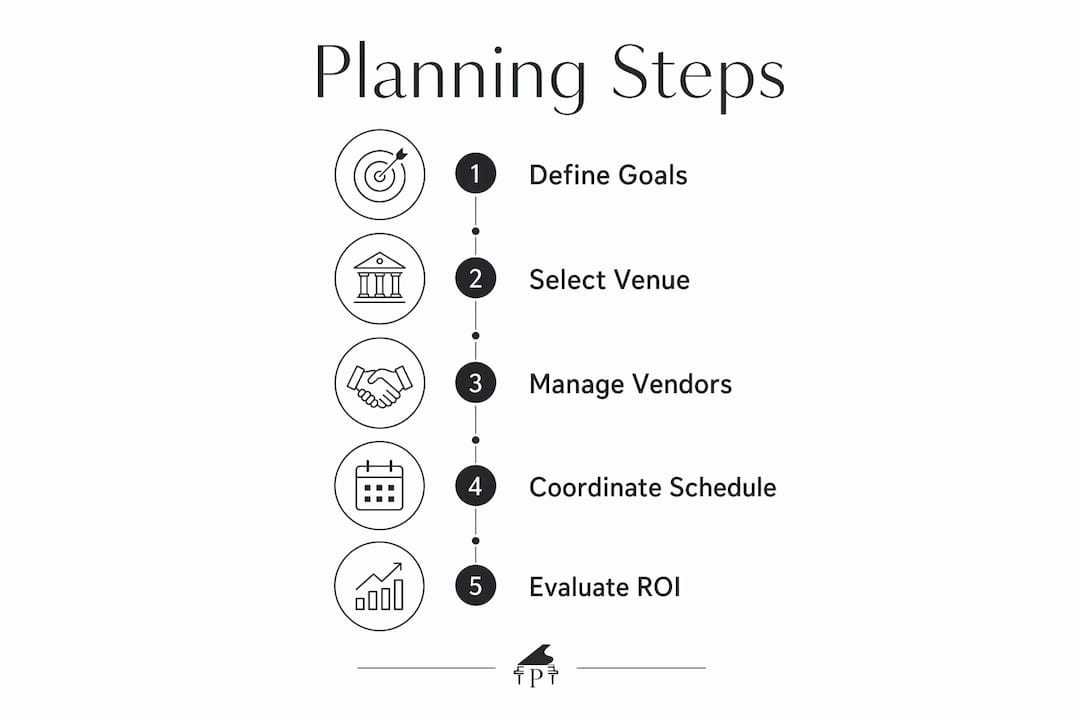
Professional event planning follows a specific sequence. Skipping steps or reordering them creates expensive problems later. The most common mistake planners make is choosing a venue before defining business goals, which leads to misaligned decisions that no amount of decoration can fix.
Define event goals and KPIs. Every decision flows from this step. Are you generating leads, rewarding employees, launching a product, or building client relationships? Name the goal, then assign a measurable KPI to it.
Set the budget with a contingency reserve. Build your full budget, then add an 8–12% contingency fund on top. That buffer covers last-minute vendor changes, weather-related costs, and the surprises that always appear in the final 72 hours.
Build a milestone timeline. Mid-sized events require 8–12 weeks of preparation. Large-scale conferences and galas need 6–12 months. Work backward from the event date and assign deadlines for venue confirmation, vendor contracts, marketing, and run-of-show delivery.
Assemble your vendor team. A mid-sized event typically spans 10–20 vendor categories. Identify each category early, issue RFPs simultaneously, and set a single deadline for proposals.
Lock strategy before logistics. Locking in event strategy before booking vendors prevents wasted spend and keeps every element aligned with the core business goal.
Build and distribute the run-of-show. A run-of-show document schedules every minute of the event day and synchronizes all stakeholders. It is the single most effective tool for managing onsite risk.
Pro Tip: Send the run-of-show to every vendor at least five business days before the event. Vendors who receive it the night before make more errors and ask more questions on the day itself.
How do you select the right venue and manage vendors?
Venue selection is the decision that shapes every other logistical choice. The right venue makes vendor coordination easier. The wrong one creates friction at every turn.
Key venue criteria
Capacity and layout. The space must fit your attendee count comfortably, with room for registration, breakout sessions, and networking areas.
Location and accessibility. Proximity to airports, hotels, and public transit directly affects attendance rates.
AV infrastructure. Venues with built-in AV systems reduce rental costs and setup time. Always ask for a full AV inventory before signing.
Catering policies. Some venues require exclusive use of their in-house catering. That limits your options and often increases food and beverage costs.
Flexibility for entertainment. If you plan to bring in live entertainment, confirm load-in access, power capacity, and noise restrictions before committing.
Managing a large vendor roster
Mid-sized corporate events coordinate 10–20 vendor categories, including catering, AV, security, transportation, floral, photography, and entertainment. That number surprises executives who have never managed an event at scale. Each vendor needs a contract, a timeline, and a clear point of contact.

The most effective vendor management approach uses a single master timeline shared with all vendors. Every delivery window, setup time, and breakdown deadline lives in one document. Pre-event production meetings, held one to two weeks before the event, catch conflicts before they become onsite emergencies.
Pro Tip: Assign one internal team member as the sole point of contact for all vendors on event day. Multiple contacts create confusion and slow down decisions when speed matters most.
Vendor category | Lead time needed | Key contract term to watch |
Venue | 6–12 months | Exclusivity and cancellation clauses |
Catering | 8–12 weeks | Per-head minimums and menu lock date |
AV and production | 8–12 weeks | Equipment substitution policy |
Entertainment | 4–8 weeks | Performance duration and tech rider |
Transportation | 2–4 weeks | Overtime rates and driver-to-guest ratio |
What role does entertainment play in corporate event success?
Entertainment is not a reward for finishing the planning work. It is a planning decision that shapes the entire event experience. The best event managers treat AV, staging, lighting, and live performance as integrated systems, not accessories added after the budget is nearly spent.
Production elements set the emotional tone of an event before a single speaker takes the stage. Lighting design signals formality or energy. Sound quality determines whether attendees stay engaged or tune out. Stage design communicates brand values without a word being spoken. Treating these elements as afterthoughts is the fastest way to undercut an otherwise well-planned event.
Entertainment options that work for corporate events
Live music. A live pianist, jazz trio, or string quartet creates ambient atmosphere during receptions and dinners without competing with conversation. Live music also signals investment and attention to detail to attendees. For Southern California events, Platinumpianist brings a live piano performance that elevates the room from the moment guests arrive.
Keynote performers and speakers. Motivational speakers, comedians, or industry thought leaders work well for general sessions and closing programs.
Interactive experiences. Photo booths, live art installations, and team-building activities increase engagement during networking periods.
Unique cultural acts. Specialty performers add distinction to events that need to stand out. Understanding how unique entertainment fits event programming helps planners match the act to the audience.
Entertainment and production typically consume 30–50% of a total event budget. That allocation reflects the outsized impact these elements have on attendee perception and memory. An event with average food but exceptional entertainment is remembered as a great event. The reverse is rarely true.
How do you measure success and ROI from corporate events?
ROI measurement starts before the event, not after. Defining success metrics before the event begins is the only way to collect the right data and make a credible case for future investment.
Set KPIs at the goal-setting stage. Attendance rate, lead volume, Net Promoter Score, session ratings, and social media reach are common metrics. Choose the ones that match your event type.
Run post-event surveys within 48 hours. Response rates drop sharply after two days. Keep surveys to five questions or fewer and focus on experience quality and goal achievement.
Reconcile the budget weekly during planning, and fully within two weeks after the event. Tracking actual costs weekly and targeting less than 3% variance keeps the final reconciliation clean and defensible to finance.
Conduct vendor debriefs. A 30-minute call with each major vendor surfaces what worked, what failed, and what to change next time. Most planners skip this step and repeat the same vendor-related problems at the next event.
Align ROI reporting to event type. A lead-generation event measures pipeline value. An internal all-hands measures employee engagement scores. A client appreciation dinner measures retention and relationship depth. Applying the wrong metric to the wrong event type produces meaningless data.
The most common ROI mistake is measuring attendance against capacity and calling it success. A full room with low engagement and no follow-through delivers no business value. Track outcomes, not headcounts.
Key Takeaways
A corporate event planner delivers business results by locking in strategy before logistics, managing vendors with a single master timeline, and measuring outcomes against pre-set KPIs.
Point | Details |
Strategy before venue | Define business goals and KPIs before selecting a venue or booking vendors. |
Budget with a buffer | Add an 8–12% contingency reserve to every event budget to cover unforeseen costs. |
Timeline discipline | Allow 8–12 weeks for mid-sized events and 6–12 months for large-scale conferences. |
Entertainment as strategy | Treat AV, staging, and live performance as core event systems, not optional extras. |
ROI starts pre-event | Set measurable success metrics before the event begins to collect meaningful data. |
What I’ve learned after years of watching corporate events succeed and fail
The single biggest predictor of a great corporate event is not the venue or the budget. It is whether the planner had a clear business objective before any vendor was contacted. I have watched well-funded events fall flat because the planning team started with “we need a venue that holds 300 people” instead of “we need to generate 50 qualified leads.” The venue question answers itself once the goal is clear.
The second thing I have learned is that entertainment decisions made late in the process are almost always compromises. When AV, staging, and live performance are brought into the conversation early, they shape the room layout, the run-of-show, and the attendee flow. When they are added at the end, they create conflicts with everything already locked in. Planners who treat entertainment as a line item to fill rather than a tool to deploy consistently produce forgettable events.
Stakeholder management is the skill that separates good planners from great ones. Executives change their minds. Budgets get cut. Guest lists grow. The planners who handle these shifts without losing momentum are the ones who built enough contingency into the plan from the start, and who communicate changes clearly and quickly. If you are planning your first large-scale corporate event, build more buffer than you think you need. You will use it.
— Petra
Live piano music that makes your corporate event memorable
Corporate events need entertainment that fits the room and the audience. Live piano music does exactly that. It creates atmosphere during cocktail hours and dinners, signals professionalism to clients and guests, and gives your event a quality that recorded music simply cannot replicate.

Platinumpianist brings a grand piano and a full live performance to corporate events across Southern California. Whether you are planning a client reception in Beverly Hills or a company dinner in Los Angeles, the experience is ready to book. You can also browse company party entertainment ideas to see how live music fits different event formats. For bookings and availability, visit the Beverly Hills pianist page or the Los Angeles live musician page to get started.
FAQ
What does a corporate event planner do?
A corporate event planner manages the full lifecycle of a company event, including goal setting, budgeting, vendor coordination, production oversight, and post-event ROI reporting. The role ties every logistical decision to a specific business objective.
How far in advance should you start planning a corporate event?
Mid-sized events with 100–300 attendees require 8–12 weeks of preparation. Large-scale conferences and galas need 6–12 months of lead time to secure venues, vendors, and production resources.
How much should you budget for entertainment and production?
Entertainment and production typically account for 30–50% of a total corporate event budget. Treating AV, staging, and live performance as integrated systems rather than add-ons produces better results and fewer last-minute cost overruns.
What is a run-of-show and why does it matter?
A run-of-show is a minute-by-minute schedule that coordinates all vendors, speakers, and staff throughout the event day. It is the primary tool for managing onsite risk and keeping the event on schedule.
How do you measure ROI from a corporate event?
Set specific KPIs before the event, such as lead volume, attendance rate, or Net Promoter Score, then collect data through post-event surveys and budget reconciliation. Aligning metrics to the event type, whether lead generation, brand awareness, or employee engagement, produces the most meaningful results.
Recommended


